

Reading Worlds in Light: A Career from Spectral Mapping to Thermal Physics—and from Ocean Worlds to Terrestrial Surfaces
Affiliation: INAF-IAPS, Roma (Italy)

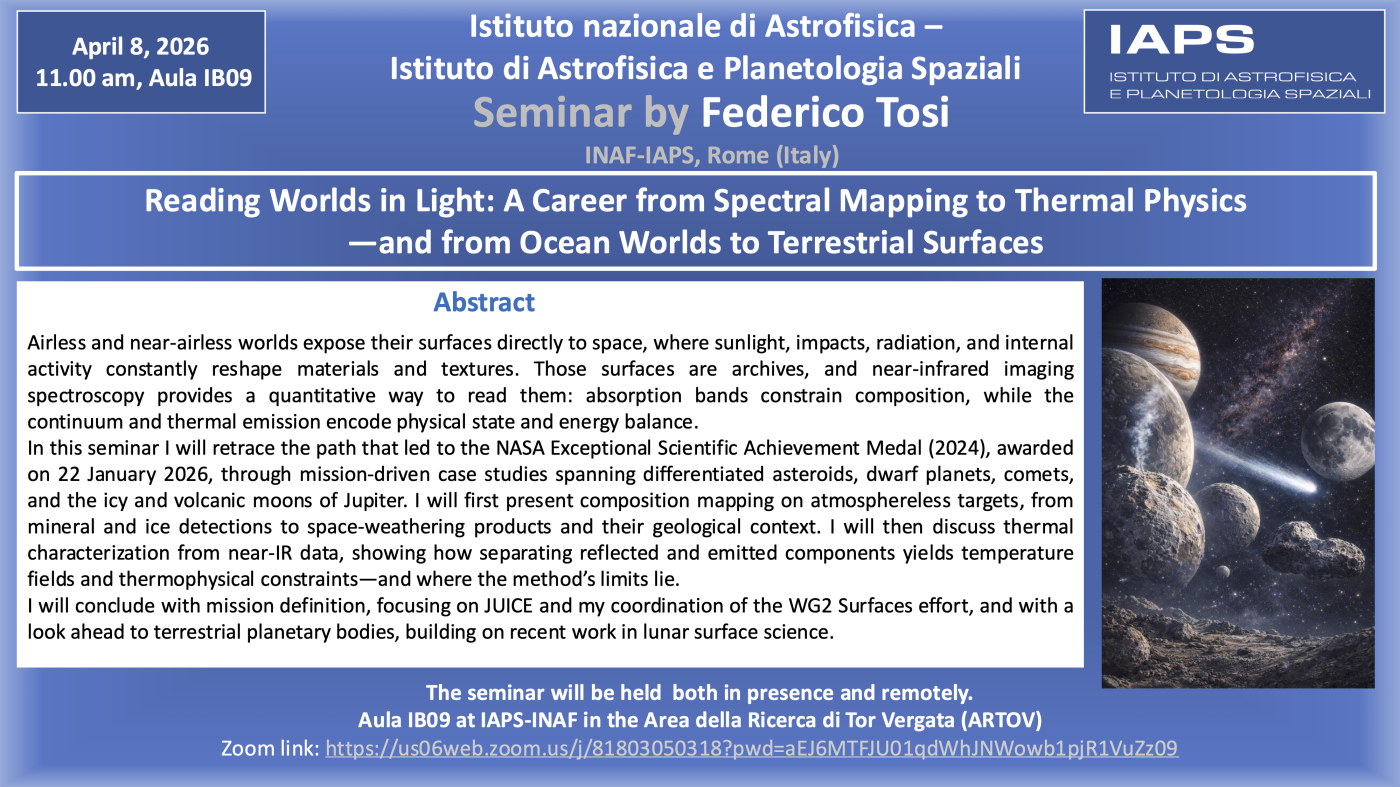
Airless and near-airless worlds expose their surfaces directly to space, where sunlight, impacts, radiation, and internal activity constantly reshape materials and textures. Those surfaces are archives, and near-infrared imaging spectroscopy provides a quantitative way to read them: absorption bands constrain composition, while the continuum and thermal emission encode physical state and energy balance.
In this seminar I will retrace the path that led to the NASA Exceptional Scientific Achievement Medal (2024), awarded on 22 January 2026, through mission-driven case studies spanning differentiated asteroids, dwarf planets, comets, and the icy and volcanic moons of Jupiter. I will first present composition mapping on atmosphereless targets, from mineral and ice detections to space-weathering products and their geological context. I will then discuss thermal characterization from near-IR data, showing how separating reflected and emitted components yields temperature fields and thermophysical constraints—and where the method’s limits lie.
I will conclude with mission definition, focusing on JUICE and my coordination of the WG2 Surfaces effort, and with a look ahead to terrestrial planetary bodies, building on recent work in lunar surface science.