

Insights into icy moon-magnetosphere interactions: the unique case of Ganymede
Affiliation: INAF-IAPS


Currently, our understanding of moon-magnetosphere interactions is largely based on the analysis of data collected during previous and ongoing missions to the outer solar system. Additionally, telescope observations of giant planets and their moons have provided valuable insights, fostering a broader and more nuanced perspective on the related physical phenomena. Advancements in space plasma physics and numerical simulations have been playing a crucial role in enhancing our comprehension of near-moon environments, the fundamental physical processes involved, and their variability over both short and long timescales.
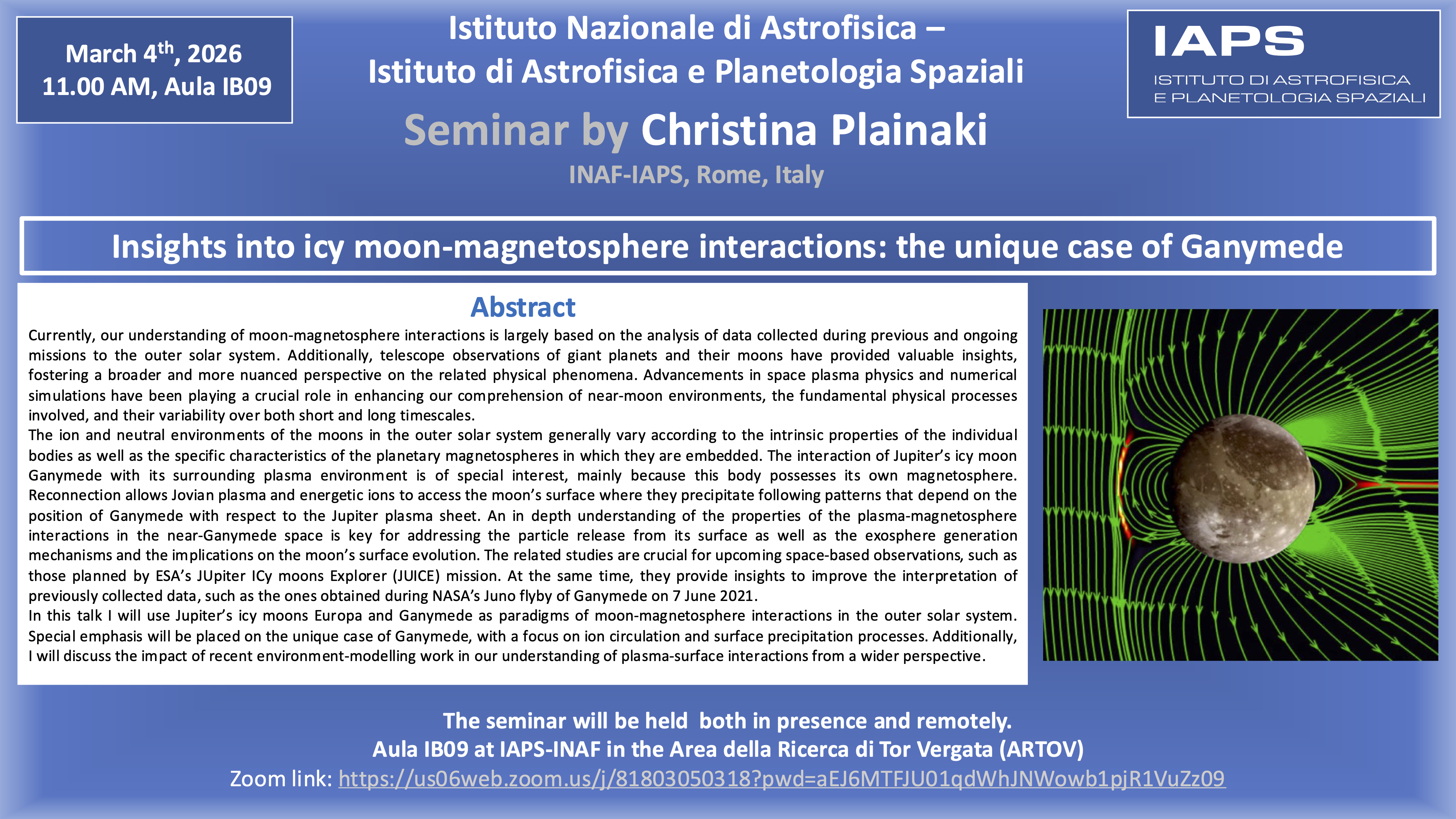
The ion and neutral environments of the moons in the outer solar system generally vary according to the intrinsic properties of the individual bodies as well as the specific characteristics of the planetary magnetospheres in which they are embedded. The interaction of Jupiter’s icy moon Ganymede with its surrounding plasma environment is of special interest, mainly because this body possesses its own magnetosphere. Reconnection allows Jovian plasma and energetic ions to access the moon’s surface where they precipitate following patterns that depend on the position of Ganymede with respect to the Jupiter plasma sheet. An in depth understanding of the properties of the plasma-magnetosphere interactions in the near-Ganymede space is key for addressing the particle release from its surface as well as the exosphere generation mechanisms and the implications on the moon’s surface evolution. The related studies are crucial for upcoming space-based observations, such as those planned by ESA’s JUpiter ICy moons Explorer (JUICE) mission. At the same time, they provide insights to improve the interpretation of previously collected data, such as the ones obtained during NASA’s Juno flyby of Ganymede on 7 June 2021.
In this talk I will use Jupiter’s icy moons Europa and Ganymede as paradigms of moon-magnetosphere interactions in the outer solar system. Special emphasis will be placed on the unique case of Ganymede, with a focus on ion circulation and surface precipitation processes. Additionally, I will discuss the impact of recent environment-modelling work in our understanding of plasma-surface interactions from a wider perspective.