

The European Space Agency (ESA) has selected Plasma Observatory as its next medium-class scientific mission, M7. The mission, proposed by an international consortium led by Maria Federica Marcucci, a researcher at INAF-IAPS in Rome, together with Alessandro Retinò of the Laboratoire de Physique des Plasmas (LPP-CNRS) in Paris, will study the physical processes governing energy transfer in the plasma surrounding the Earth.
Plasma Observatory will consist of seven identical satellites, which will fly in formation along a highly elliptical orbit. By simultaneously observing magnetic and electric fields and particles from seven different points, the mission will be able to track phenomena occurring on different spatial and temporal scales and understand how small, very rapid processes are linked to changes on a much larger scale. Plasma constitutes over 99 per cent of the visible matter in the Universe and is present in the Sun, in stars and in interplanetary space. The Sun continuously emits it in the form of the solar wind, which reaches the Earth and interacts with the magnetosphere, the region dominated by the Earth’s magnetic field. Studying these processes close to our planet therefore provides a natural laboratory for understanding physical phenomena that also occur in much more distant environments.
This selection marks the conclusion of a process that began in 2022 with the ESA’s call for proposals for the M7 mission. Out of the 27 initial proposals, Plasma Observatory successfully progressed through the subsequent stages of scientific and technical evaluation, culminating in the formal decision by ESA Member States on 19 November 2026. The launch is scheduled for 2038.
“With today’s decision, Plasma Observatory has been officially selected as ESA’s next medium-class mission,” comments Maria Federica Marcucci, the mission’s principal investigator. “It marks the culmination of a long and rigorous process, but above all the start of a new phase: now the scientific vision we have developed together with the international community must be translated into instruments, satellites and operations. It is a challenge we face with enthusiasm and with a full awareness of the responsibility entrusted to us.”
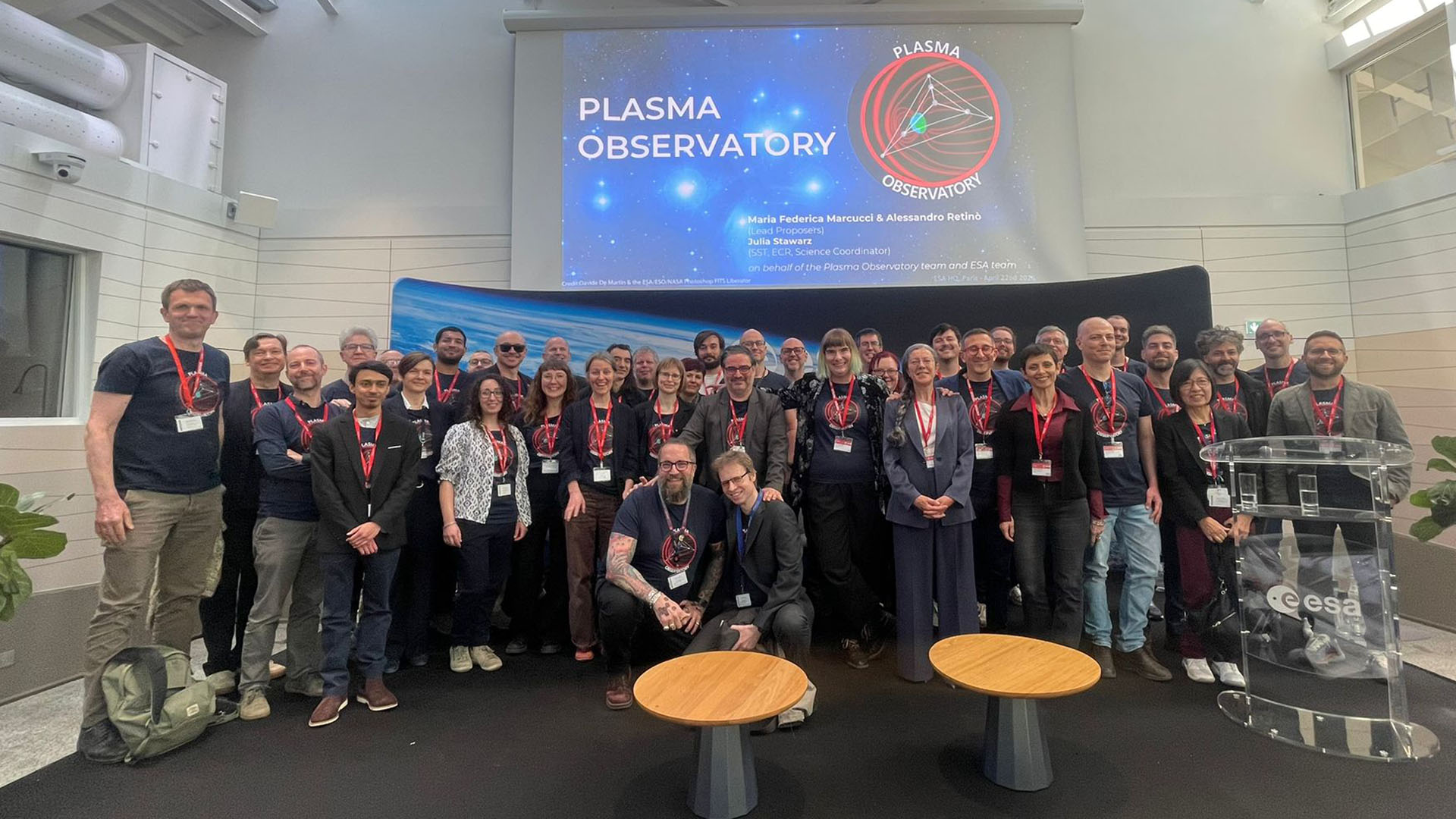 Plasma Observatory Team. Credits: Esa
INAF will also play a central role in the scientific instrumentation. Italy will supply the IMCA (Ion Mass Composition Analyser), an ion mass spectrometer developed by an international consortium led by the INAF, which will measure how different ionic species are accelerated and transported in the space around the Earth. INAF will also share responsibility for Box-P, the digital unit that will act as an interface between the satellite, the three particle-detecting instruments and the magnetometer, whilst also handling on-board data acquisition and processing.
Plasma Observatory will build on the scientific legacy of missions such as Cluster, expanding their ability to simultaneously observe phenomena on different scales. With seven coordinated satellites, the mission will, for the first time, be able to reconstruct the multi-scale dynamics of plasma in the Earth’s magnetosphere, tracing the path of energy from the solar wind to the environment surrounding our planet.