

Lucy in the sky with Trojan asteroids
Affiliation: Southwest Research Institute, Boulder, Colorado, USA


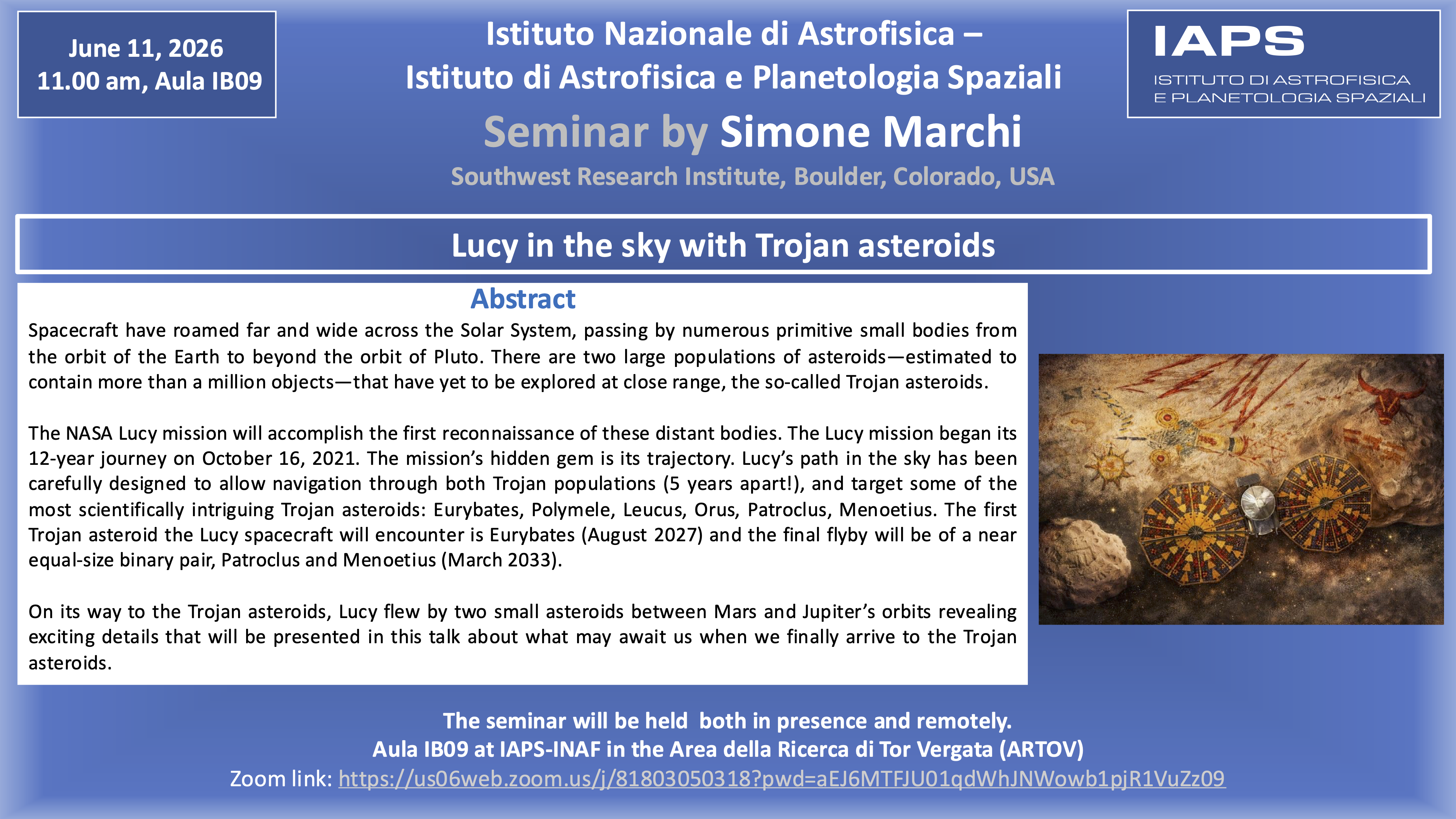
Spacecraft have roamed far and wide across the Solar System, passing by numerous primitive small bodies from the orbit of the Earth to beyond the orbit of Pluto. There are two large populations of asteroids—estimated to contain more than a million objects—that have yet to be explored at close range, the so-called Trojan asteroids.
The NASA Lucy mission will accomplish the first reconnaissance of these distant bodies. The Lucy mission began its 12-year journey on October 16, 2021. The mission’s hidden gem is its trajectory. Lucy’s path in the sky has been carefully designed to allow navigation through both Trojan populations (5 years apart!), and target some of the most scientifically intriguing Trojan asteroids: Eurybates, Polymele, Leucus, Orus, Patroclus, Menoetius. The first Trojan asteroid the Lucy spacecraft will encounter is Eurybates (August 2027) and the final flyby will be of a near equal-size binary pair, Patroclus and Menoetius (March 2033).
On its way to the Trojan asteroids, Lucy flew by two small asteroids between Mars and Jupiter’s orbits revealing exciting details that will be presented in this talk about what may await us when we finally arrive to the Trojan asteroids.