

The Interstellar Mapping and Acceleration Probe (IMAP): NASA’s New Heliophysics Flagship
Affiliation: Department of Astrophysical Sciences, Princeton University, Princeton, NJ 08544, USA
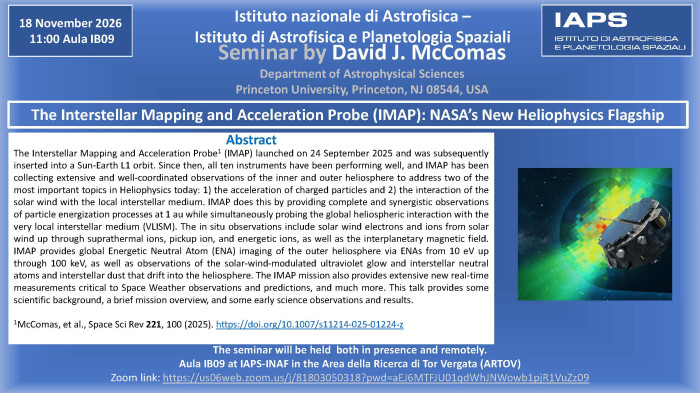
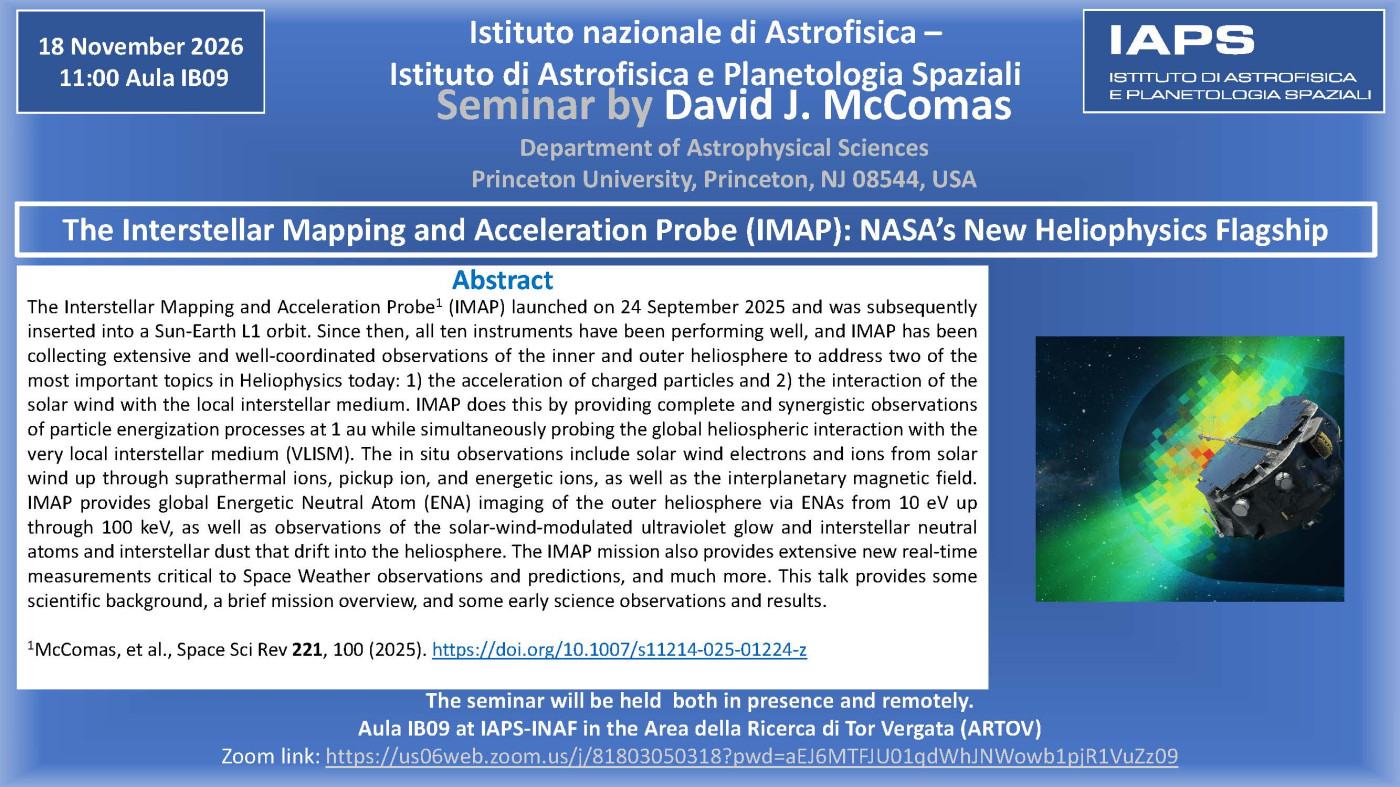
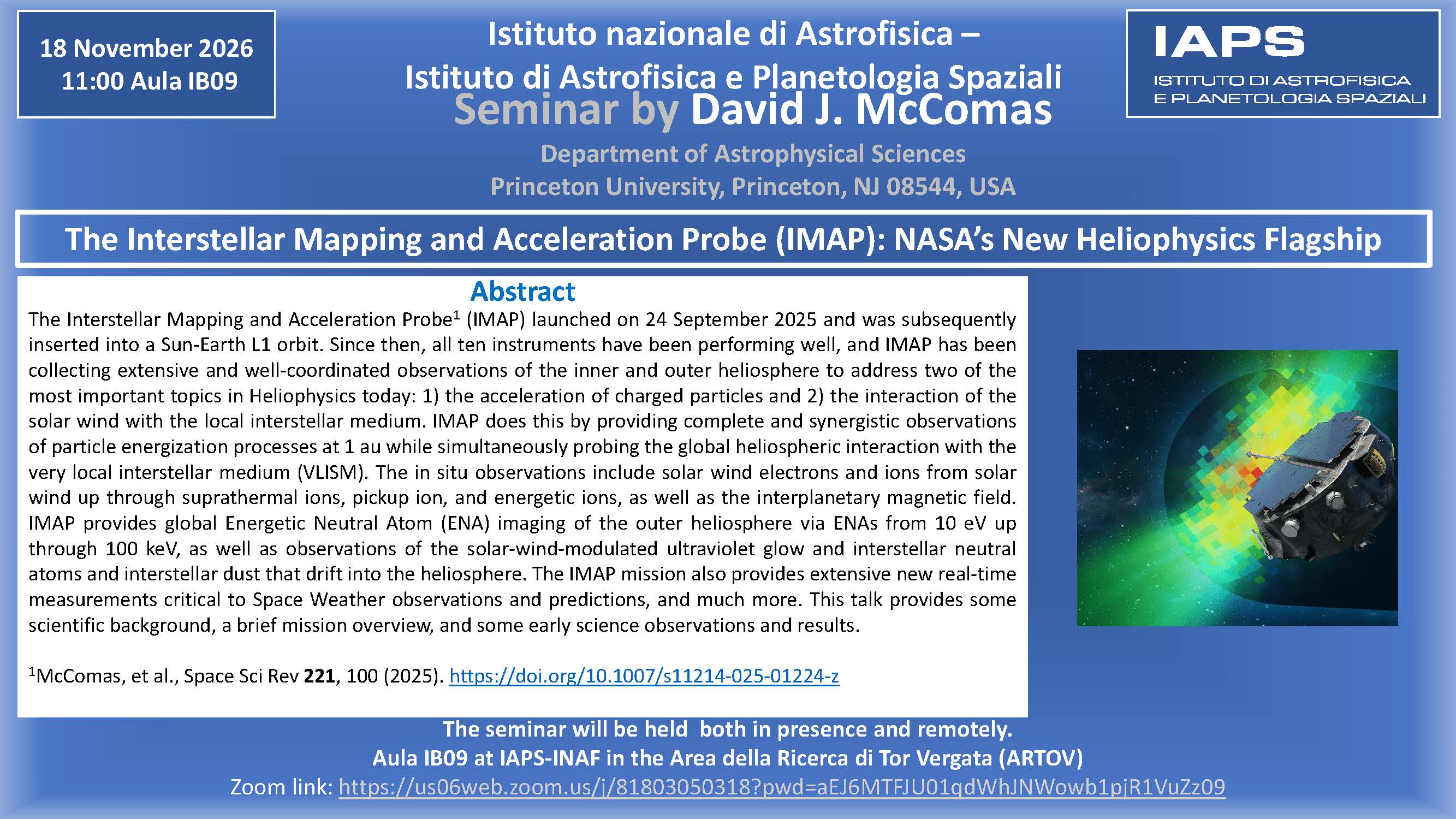
The Interstellar Mapping and Acceleration Probe1 (IMAP) launched on 24 September 2025 and was subsequently inserted into a Sun-Earth L1 orbit. Since then, all ten instruments have been performing well, and IMAP has been collecting extensive and well-coordinated observations of the inner and outer heliosphere to address two of the most important topics in Heliophysics today: 1) the acceleration of charged particles and 2) the interaction of the solar wind with the local interstellar medium. IMAP does this by providing complete and synergistic observations of particle energization processes at 1 au while simultaneously probing the global heliospheric interaction with the very local interstellar medium (VLISM). The in situ observations include solar wind electrons and ions from solar wind up through suprathermal ions, pickup ion, and energetic ions, as well as the interplanetary magnetic field. IMAP provides global Energetic Neutral Atom (ENA) imaging of the outer heliosphere via ENAs from 10 eV up through 100 keV, as well as observations of the solar-wind-modulated ultraviolet glow and interstellar neutral atoms and interstellar dust that drift into the heliosphere. The IMAP mission also provides extensive new real-time measurements critical to Space Weather observations and predictions, and much more. This talk provides some scientific background, a brief mission overview, and some early science observations and results.
1McComas, et al. Interstellar Mapping and Acceleration Probe: The NASA IMAP Mission. Space Sci Rev 221, 100 (2025). https://doi.org/10.1007/s11214-025-01224-z