

In the cryogenic laboratory for X-ray Astrophysics, we develop cutting-edge technologies for observing the X-ray sky from space. Our final goal is the study of the hottest components and the most energetic phenomena of the Universe, which requires high energy-resolution and low background detectors. These are based on sensitive superconducting thermometers called TES (Transition Edge Sensor), which works at temperatures close to the absolute zero point (T=50 mK, about -273 °C). To reach this temperature, the laboratory exploit two complex refrigerator systems: a dilution cryostat and an adiabatic demagnetization refrigerator. At present, our work is mainly focused on the development of a TES detector for the ESA ATHENA mission, a large X-ray observatory to be launched in 2037.
In detail
The laboratory in question houses three cryostats typically used for characterising detectors and readout electronics at temperatures ranging from approximately 3 K to approximately 20 mK. All these cryostats are of the ‘dry’ type, meaning they do not require liquid cryogens to be ‘leaked’ in order to reach their target temperatures, as they operate in a ‘closed-cycle’ system.
In particular, these cryostats are driven by:
-
An He3/He4 dilution refrigerator (Tbase < 10 mK) coupled to a pulse tube (Tbase < 3 K) to pre-cool the dilution insert
-
A Vericold ADR (Adiabatic Demagnetisation Refrigerator) (Tbase < 50 mK) coupled with a pulse tube (Tbase < 4 K) to pre-cool the ADR insert. The cryostat operates within an EMI-shielded enclosure, with IN/OUT signals filtered by low-pass filters, and a mu-metal shield to attenuate external magnetic fields
-
A Transmit Pulse Tube (Tbase < 3 K)
All Pulse Tubes operate with He6 gas. All these cryostats are equipped with PID-type active temperature control systems, and are therefore fitted with dedicated instrumentation. All three are also provided with two optical ports down to the lowest-temperature stage, usually sealed with blind flanges.
Typically, the vacuum level at which cooling begins – achieved using dry pumps in both the pre-vacuum stage and the subsequent stage – is between 10⁻² and 10⁻³ mbar, depending on the cryostat, to reach a final operating pressure of between 10⁻⁵ and 10⁻⁶ mbar. All environmental parameters (temperatures, pressures, vacuum levels, etc.) are acquired using software either developed by us (National Instruments software) or proprietary software developed by the parent company.
The use of these cryostats is necessary to characterise superconducting cryogenic detectors based on TES (Transition Edge Sensor) and the associated cryogenic readout electronics based on SQUID (Superconducting Quantum Interference Device), both for R&D developments and for enabling technologies adopted on board the Athena mission for the X-IFU (a particle anti-collision detector known as CryoAC).
Technical specifications
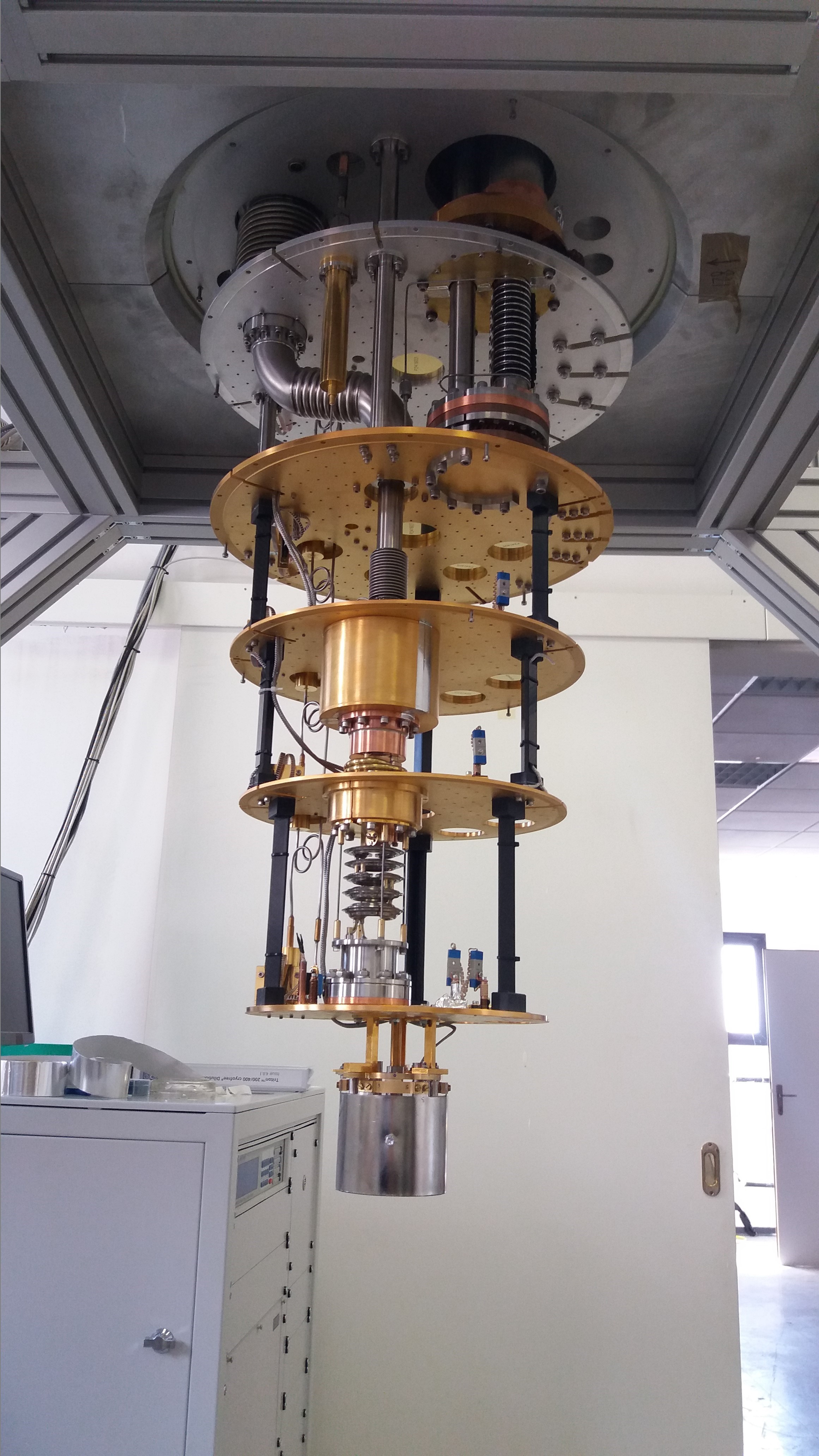
Dilution refrigerator (Oxford Triton DU7 – 500):
- Volume at T < 100 mK: ~ 11 litri (Φ = 240 mm, h = 240 mm)
- Cooling power @100mK: > 450 μW
- Cooling power @50mK: 115 μW
- Cooling power @4.2K: 1.5 W
- Cooling power @45K: 40 W
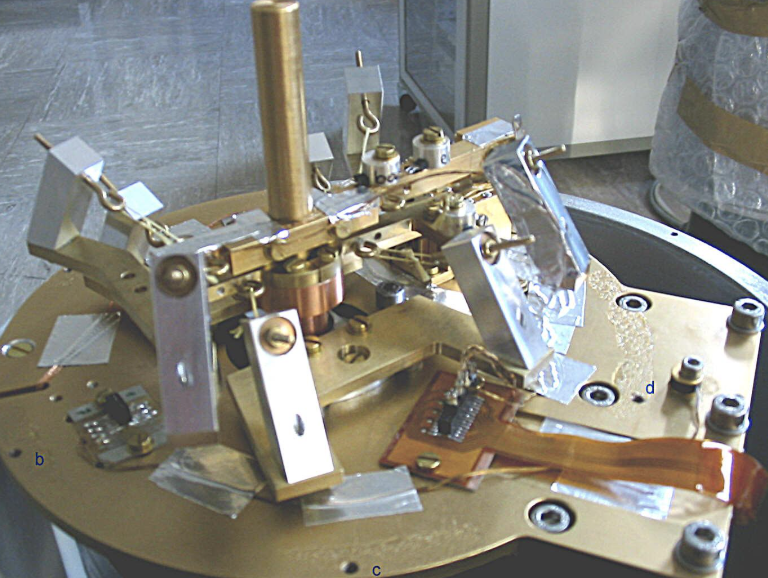
Adiabatic demagnetisation cooler (VERICOLD):
- Volume at T < 100 mK: ~ 1.2 litri (Φ = 160 mm, h = 60 mm)
- Cooling energy (zero carico)@100mK: 83 mJ
- Cooling energy (zero carico)@ 50mK: 17 mJ
- Cooling power (zero carico) @4K: 0.35 W
- Cooling power (zero carico) @50K: 5 W
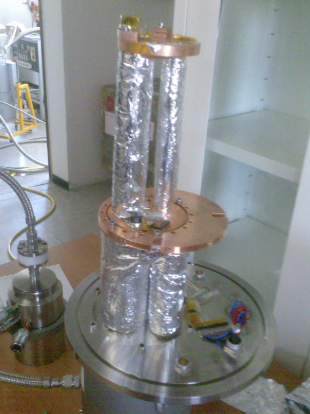
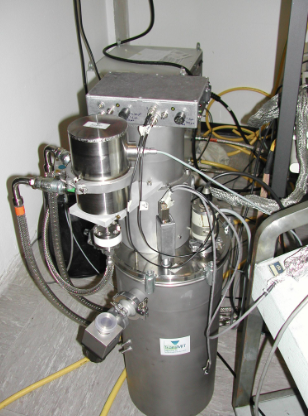
Pulse Tube cooler (Transmit PTD-406C):
- Volume a T = 4 K: ~ 3.2 litri (Φ = 162 mm, h = 160 mm)
- Cooling power @4K: 0.4 W
- Cooling power @38K: 5 W
As the Pulse Tubes are connected to compressors that cycle He6 gas, these compressors must be water-cooled. This facility is equipped with a closed-loop chiller that enables this operation. The dilution refrigerator requires liquid nitrogen to cool an external trap, which is used to keep the He3/He4 mixture pure. Typical consumption is 180 litres of liquid nitrogen per month of operation. Operating the cryostats requires two staff members to install the experiments and prepare the setup. Thereafter, barring unforeseen circumstances, only one staff member is required to manage operations, which are largely automated.